Monday, June 9, 2014

One coin a day - has a penny reached the status of garbage?

Recently while picking up litter at the bus stop, I found a nickel.  It was one of a number of coins I've found recently while scanning the ground, and it reminded me of a blog post I wrote in September 2006 about finding money while cycling to work.

9/29/2006
It's amazing to me how much money is just lying around in the street. Biking to work, I see coins lying in the street all the time. They sit there day after day and I'm the only one who seems to pick them up.
 This morning, at the most prolific intersection on my route, I spotted three pennies and a dime. I then picked up a quarter at the second most lucrative spot, which is on M$ campus. The first spot is about a mile and a half from home, so I just went for a walk and picked up the three pennies and a dime, plus a fourth penny I didn't see in the same spot. While I was on my way, I spotted a quarter in the gutter, and there was a nickel on the sidewalk about 2 feet away. Finally, I spotted another penny in the street about halfway to home.
 Don't know about you, but I still consider it worthwhile to pick up a penny.
The stuff that lies in the street gets all scuffed up - sometimes to the point where they are unrecognizable. 
Here's today's haul. All but the scuffed quarter were picked up on my walk just now.

One Coin A Day?
It makes me wonder:  in this affluent suburb, why don't we stop to pick up change?  Is it that the perceived value is so low?  Is it just unseen?  Or are we sending the same message with coins as we are with garbage:  that it's beneath us to bow to the ground and pick something up there, or that anything that has touched the ground is automatically contaminated?

Would you stop to pick up a coin on the ground?  Why or why not?

Monday, June 2, 2014

What MH370 is teaching us about ocean debris

March 8th of this year, Malaysian airlines flight MH370 disappeared.  The baffling disappearance is a mystery that persists 86 days later despite what is perhaps the most technologically sophisticated search conducted to date.

While the disappearance of the flight remains an unsolved mystery, one side effect of the intense search has been to focus attention on the large amount of man-made floating debris in the most remote parts of the ocean, everything from lost or discarded fishing gear to entire lost shipping containers.

“Search efforts intensified on 20 March, after large pieces of possible debris had been photographed in this area four days earlier by a satellite. Australia, the United Kingdom, the United States, China, Japan, New Zealand, and South Korea assigned military and civilian ships and aircraft to the search. China published images from satellite Gaofen 1 on 22 March that showed large debris about 120 km (75 mi) south west of the previous sighting. On 26 March, images from French satellites indicated 122 floating objects in the southern Indian Ocean. Thai satellite images published on 27 March showed about 300 floating objects about 200 km (120 mi) from the French satellites' target area. The abundant finds, none yet confirmed to be from the flight, brought the realisation of the prior lack of surveillance over the area, and the vast amounts of marine debris littering the oceans.” - Wikipedia: Malaysia Airlines Flight 370.

The referenced Wikipedia article has pulled together many of the reports of marine debris fields discovered in the vast and remotest parts of the Southern Indian Ocean, sourced from plane overflights, search vessels, and some of the largest from satellite imagery.  Imagine, garbage fields visible from space!

Can this ocean of garbage be cleaned up?  Unlikely.  The effort required to collect large amounts of garbage in remote and untraveled areas is prohibitive, and represents a drop in a very large bucket.  It’s hard to know how to start to help.  A large proportion of the garbage in remote areas comes from huge shipping containers lost overboard, loss of equipment from large-scale fishing operations.  However, some proportion of it is undoubtedly sourced on land, from household garbage.

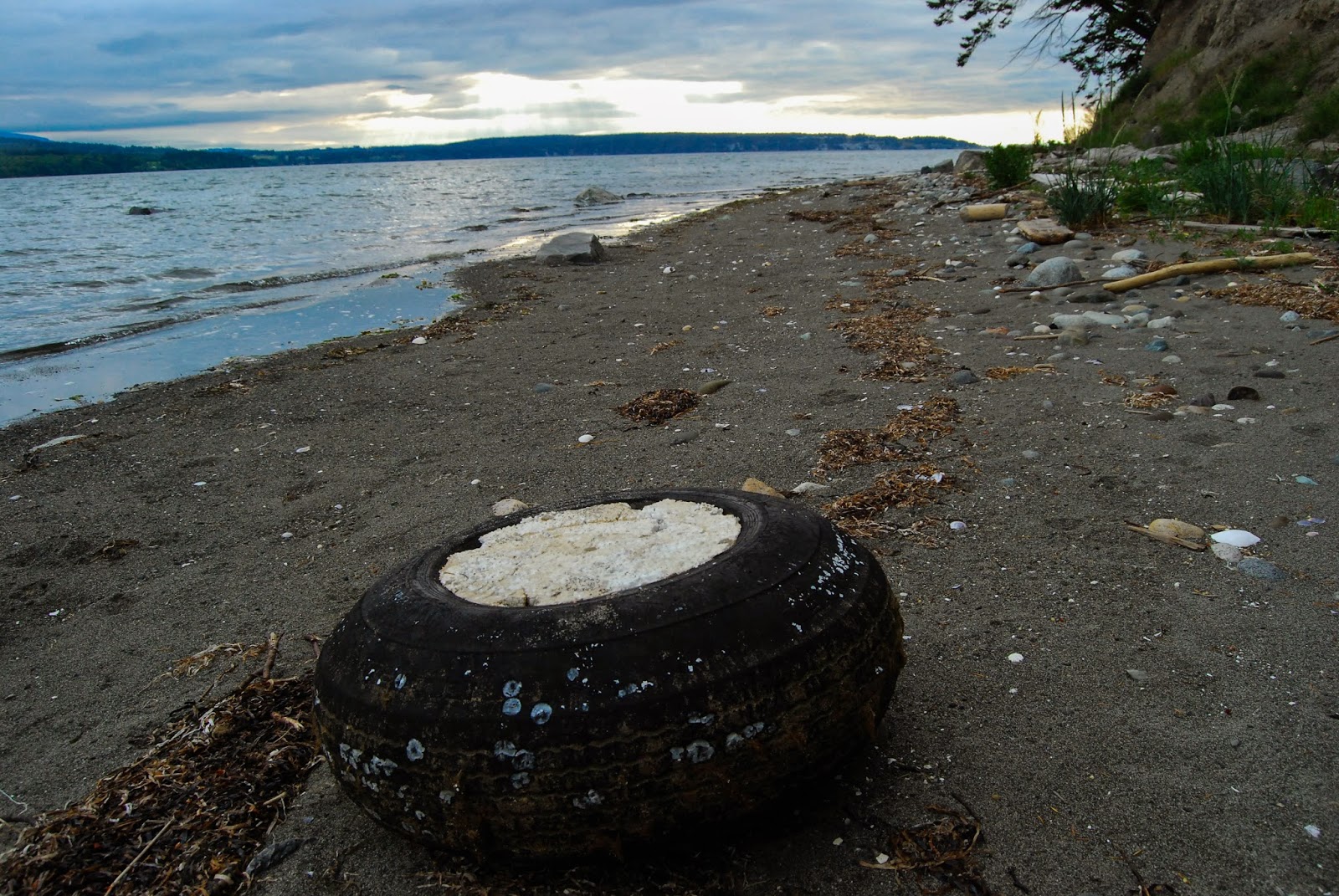
On a recent visit to Port Townsend, Washington State’s quaint Victorian arts community and tourist haven, I walked the beaches along Discovery Bay, and was reminded of the lessons of MH370 by the trash all over the littoral zone.  I picked up a nice pile of plastic bags and sheeting. 


 I left the tires. 


It makes me feel helpless to think of the insurmountable task of cleaning up the ocean.  What I can do is small but impactful – pick up a piece or more of trash every day.  365 pieces a year.  Maybe a few thousand in a lifetime.  If we can spread this discipline, teach our kids, get 100, 1000, a million, a billion people doing the same, will it end the problem?  No, but it’s a start.  

Join me, won’t you?

Monday, February 3, 2014

The scoop about trash and wildlife: check your facts before you act

A good friend recently contacted me on Facebook, sending me a graphic that warned of the danger that discarded chewing gum poses to small birds. “Thank you for your counter-litterbug blog and activities.” she wrote. “This reminded me of you!” 

I’ve mentioned threats to wildlife before, and this seemed like a good prod in the direction of a full post devoted to specific wildlife threats.  I've heard a few horror stories: marine birds and other animals snarled in plastic six-pack rings, pigeons exploding after eating processed rice, and now, gum mistaken for bread by unsuspecting finches. 

Only, as it turns out, none of these appear to stand up to inspection.

We are a soundbite culture, and it is tempting to grasp onto something simple and graphic and rally behind it.  For example, there are documented cases of seabirds and other wildlife caught in the plastic rings used to hold soda cans.  It’s a shocking picture, and it’s easy to hold in your mind.  It’s a simple thing to talk about, and it makes us feel like heroes when we cut up the rings before putting them in the trash.

However, plastic rings are not the top culprit in the entanglement and death of animals, marine or otherwise.  Far more animals are snared in discarded nets and fishing line.  Here’s one article that summarizes the issue well:  http://www.straightdope.com/columns/read/1336/should-you-cut-up-six-pack-rings-so-they-dont-choke-sea-birds.   Does this mean you shouldn’t cut up the rings?  No, but you should realize that you may not be making the impact you think you are.  It may be more helpful to ensure that the rings are part of trash that is properly bagged and discarded in a responsible landfill (yes, even landfills are getting their act together: http://environmentalchemistry.com/yogi/hazmat/articles/trash.html).

My ask is that if you read about a compelling and viral environmental issue, please check your facts before you repost.  Other examples:


So, if none of these are significant threats, what type of litter has a real impact on the natural world, and how can we best act to limit the damage?

Here are some likely culprits:

  1. Litter on beaches or in waterways.  I’ve written about the great vortex of plastic trash in the Pacific ocean and the impact it has on the ecosystem.  Keeping garbage out of waterways and off beaches seems like a great investment of time.  The threat of marine animals attempting to eat floating plastic bags is alone cited more frequently than the problem of plastic soda rings. (http://www.inthenews.co.uk/news/science/wildlife-under-threat-from-record-beach-litter-$1218176.htm, http://www.epa.gov/owow/oceans/debris/toolkit/files/Sec3.litterinwaterways508.pdf ).
  2. Pesticides and household hazardous waste.  Runoff from fields, spills from industrial operations, and storm runoff that includes the results of your last oil change have a long lasting impact, and the bioconcentration that occurs over time is a direct threat to the species at the top of the food chain (that means us).  (http://www.chintiminiwildlife.org/Education/LivingWithWild/Litter.htm )
  3. Cigarette butts.  Not only is nicotine a potent toxin, but cigarette filters contain toxic materials that I don’t even want to think about, let alone see leach into my soil (http://www.legacyforhealth.org/our-issues/cigarettes-and-the-environment, http://www.longwood.edu/cleanva/ciglitterarticle.htm, http://www.enn.com/wildlife/article/45874).  By the way, in case you get into the trap of thinking there’s no hope, know that some scientists are making progress on solutions  (http://www.environmentalhealthnews.org/ehs/newscience/2012/06/2012-0725-biodegradable-cigarette-filters/ ).

Those three are a good place to start.  Since researching this article, I’ve stepped up my efforts to clear the ground of cigarette butts.  I urge you to do the same.  

At least one piece, friends:  It’s for the birds.

Monday, January 13, 2014

A Rogue's Gallery: One Pic A Day (Photo Essay)

To round out 2013, I snapped a picture of one piece of litter that I picked up and threw away each day in December.  

Presented for your edification and delight, here is my "litter-ary" calendar:

1 
Gasworks park
Just after lunch. 
Coffee cup.
2
Houghton park and ride
8:45 AM.
 Plastic bag w/ crushed cans.
3
 Thomas Street
9 AM.
V8 Fusion bottle.
Denny Park
9 AM.
Waxy paper bag.
5
Yale Avenue
9 AM
40 oz Bud bottle
6
  University District
8:30 AM
Party cups
7
Kirkland
9 AM
Coffee Cup
8
International District
3:30 PM
Plastic bag
9
Houghton Park n Ride
8:30 AM
Coors beer can
 
10
Stewart St. U-Park
8:30 AM
Newspaper
11
Olive St. Bus station
5:30 PM
Stranger insert
12
Finn Hill.
5:45 PM
 Adopt-a-stop duty.  
13
Supermarket parking lot
10:15 AM
Lighter
14
Houghton
10:30 AM
Cigarette butts
15
Burke Gilman Trail
9:00 AM
Hubcap
16
Houghton Park n Ride
8:10 AM
Ready-bagged recycling
17
Totem lake freeway station
8:30 AM
Camel cigarette pack
18
South Kirkland Park and ride
10:30 AM
New years eve flyer
19
Houghton park and ride
8:15 AM
Throw blanket
20
Finn Hill
2:00 PM
Wine box
21
Finn Hill
1:00 PM
Fruit cup
22
Alderwood Mall
4:30 PM
Promotional sign
23
Yale Ave.
9 AM
Water bottle
24
Downtown Kirkland
2:00 PM
Tinsel
25
Finn Hill
2:00 PM
McDonald’s bag
26
Burke Gilman trail
2:00 PM
Bar coasters
27
Bridle Trails
1:30 PM
Styrofoam to-go container
 
28
Woodland Park Zoo
3:00 PM
Ziploc bag
29
Redmond Town Center
6:30 PM
Receipt
30
Kingsgate
3:00 PM
Snyder’s Pretzel bag

31
Houghton park and ride
8:30 AM
Soda cup


Happy New Year
From
OnePieceADay!


Monday, December 30, 2013

Neptune’s plastic patch – news from the vortex


I’ve mentioned my predilection for open water swimming.  I grew up in West Los Angeles, and in the permissive 1970s, with far more autonomy than kids today are afforded, my best friend Frankie and I would frequently take the #3 bus from his home on Montana Ave. down to the beach during the summer.  We spent hours in the surf, boogie boarding and body surfing.  Later on, Frankie became proficient on a surfboard, while I excelled as a freestyle skateboarder (my proudest moment was taking 5th place in the annual Bay street freestyle competition in 1978).  Frankie went on to become a professional diver, and while my professional career has never directly involved the ocean, my jobs over the last 15 years have kept me close to some of the eminently swimmable bodies of water in the Puget Sound region – notably Lake Washington, Lake Sammamish, and Lake Union

Since I have a bee in my bonnet about garbage, and a fondness for the feeling of cool water and goose poop sliding over my skin, the thought of garbage in the water chaps, as they say, my speedo-covered ass.

I’ve rescued floating debris from a watery grave, as reported in this very blog.  I’ve braved muddy banks to retrieve things as large as a 5 gallon bucket and as small as a cigarette butt.  I’ve waded into the frigid waters of Puget sound for Styrofoam and other pollutants.  Yes, I’m mildly obsessed – thanks for your concern.

Imagine my surprise to find out recently about a global ecological calamity involving garbage in the ocean.  It’s new to me, and I suspect, new to you as well.  I’m talking about the Great Pacific Garbage Patch, aka the Pacific Trash Vortex.

The patch was originally theorized by NOAA in 1988, and discovered 9 years later by oceanographer Charles Moore (here’s his TED talk on the topic).  The patch is created by ocean currents which funnel flotsam into the North Pacific Gyre, whence it cannot escape.  The materials, largely plastics, degrade here midocean, and enter the food chain.  Toxins introduced this way can cause sickness or death in marine animals, disrupt normal hormone patterns, and eventually find their way into seafood and back into our lives. 

How can we help?  Well, one way may be to participate in International Coastal Cleanup Day, sponsored by the Ocean Conservancy – it occurred on September 21 this year.  Or, you may choose to support companies such as Electrolux or Method, which are committing to creating products made from plastic collected from  the vortex.

Better yet, if you live on or near the coast, make a point to swing by the beach to rescue one or more pieces of floating debris from in or near the water.  Every piece you keep out of an ocean, lake, or stream minimizes the opportunity for that bottle or bag to become toxic sludge in your next order of sushi.  Think about it, and act – one piece a day is a small price to pay to preserve clean water and healthy food for posterity.

Monday, December 16, 2013

Big Bellies for Trash!

The Greater Seattle Metropolitan area is going “belly up” for green technology.  Big Belly Solar is a Massachusetts company that is using technology in an innovative way to solve some of the most pervasive issues around municipal litter collection.  Their unique solar-powered compactor system attacks the litter problem on several fronts:

  • The fully enclosed design prevents weather or pests from scattering trash from bins
  • The compacting system allows their collectors to hold a greater volume of trash and therefore require less frequent collection.
  •  The units are internet-connected, and will notify their handlers electronically when they need collection

The results sound promising.  The University of Washington piloted Big Belly compactors beginning in 2011, and have realized savings as a result.   Similar programs have been started in my town of Kirkland, as well as in the City of Seattle.  It makes sense that this high tech hub would embrace this innovative combination of well-tested technologies, and by all indications the investment is paying off.  I happily deposit my daily picks in Big Belly compactors such as this one near the bus stop at Yale and Stewart.

Of course, I have my own challenges around a big belly.  Before leaving my Eastside job to work in Seattle I was rock climbing two days or more a week.  Before that I spent a couple of years studying capoeira through the excellent program at Capoeira MalĂȘs.  And prior to that, I was spending mornings before work at Crossroads Skate Park in Bellevue.

My morning workout, circa 2006 (Photo by Huck Productions)

All that ended when I started working in Seattle and traded my exercise time for 2 hours a day of commuting.  The warm season sees me swimming (and picking up marine litter).  The rest of the year, I take as much time as I can to walk.  Walking takes me to the streets, and gives me ample opportunity to dispose of one or more pieces of litter a day.  I guess you could say collecting litter helps me control my big belly, much like the way Big Belly is helping Seattle deal with litter.  

What comes around, goes around.  Make sure what goes on the ground winds up in the garbage!

Monday, December 2, 2013

What are the kids drinking these days?


One thing I notice in my avocation as self-appointed litter police is the occasional “nest” that teens and young adults create in their quest to flout alcohol age restrictions.  Sometimes these are in the bushes, sometimes in an abandoned lot, or by the side of the road.  Sometimes they are represented by collections in the garbage can at my adopt-a-stop.

I recognize these signs, because I was a teenage drinker.  At 17 or 18, my bandmates and I would drive to a local convenience or liquor store, and park outside waiting for a cool-looking adult who might buy us some beer.  We referred to it as “spotting”, as in “hey, ya wanna go spot some beer?.”  It wasn’t hard to find somebody willing. 

Once, when it was Jim’s turn to hang out and solicit potential enablers, he got a yes from a pretty twentysomething girl, who not only bought us the beer, but rewarded Jim with a long deep wet kiss for his trouble.  It’s 32 years later and I’m still jealous.

But I digress.

A few things to note about the nests this year:

  1. It’s all about the Steel Reserve.  Whether it’s my neighborhood on the Eastside or where I work in the SLU, those shiny silver cans are congregated together. No other brand seems to satisfy the thirsty teen in 2013.
  2. When they aren’t leaving cans in neat piles, they are walking down the street, leaving a trail of cans, about two to the block.
  3. Nobody seems to want to dent the smooth silvery exterior of the cans.  The picture above is typical.  Even crammed by the six pack into the adopt-a-stop bin, the cans are miraculously unmarred.
  4. They are a breeze to pick up.  Except for the shambling trail-leavers, these nests are clean, consolidated, and recyclable.
Carry on, one-piecers, and keep your eyes out for signs of nests in your neighborhood.  They are a simple way to grab some quick karma points.